
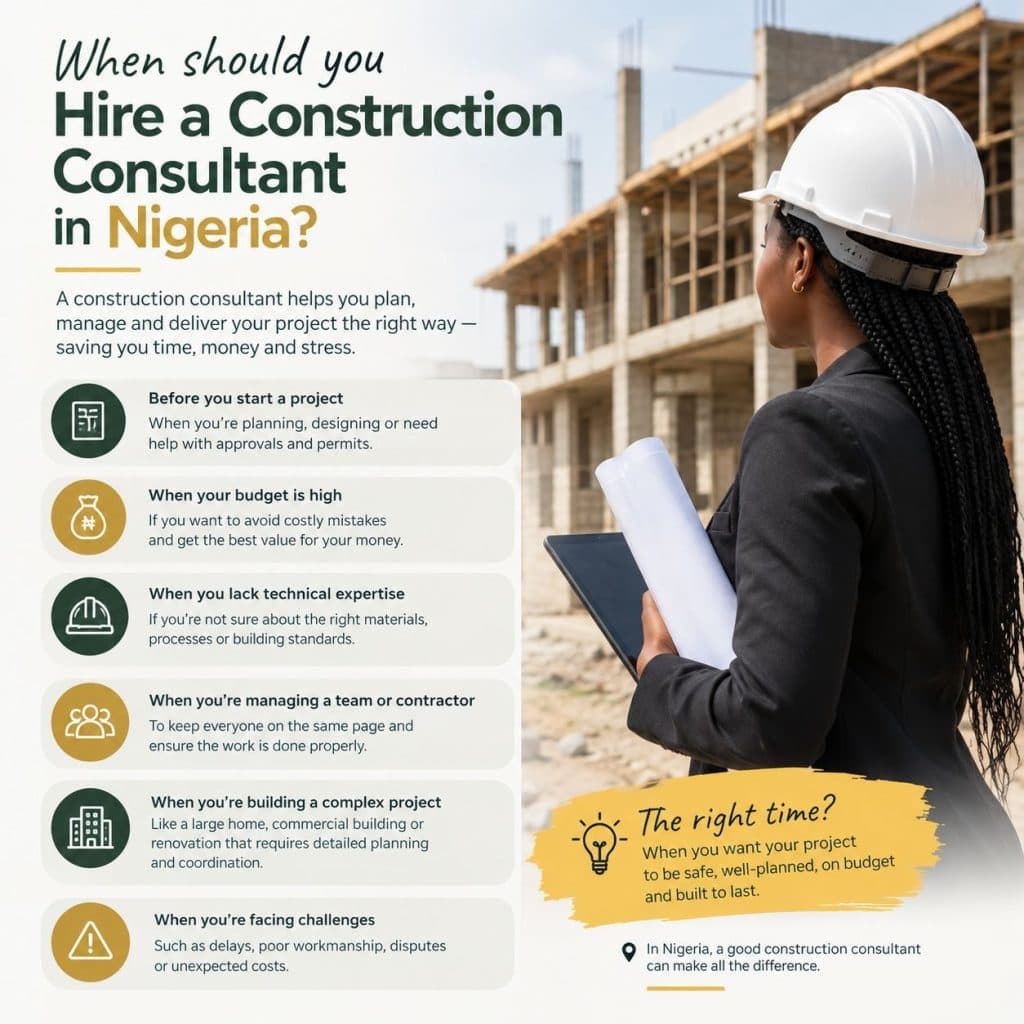
When should you hire a construction consultant in Nigeria? According to The Building Practice Ltd, engaging a qualified construction consultant during the early planning stage can help property owners make informed decisions, manage construction costs, coordinate professionals, and maintain quality throughout a building project. Whether you intend to build a residential house in Lagos, develop a commercial property in Abuja, or undertake a large-scale project elsewhere in Nigeria, professional construction consultancy can help you identify risks before they become expensive problems. More importantly, the right consultant can support your project from initial feasibility studies to construction completion, depending on the agreed scope of services.
Construction projects involve several interconnected activities, including architectural design, structural engineering, quantity surveying, contractor selection, regulatory approvals, procurement, and site supervision. Consequently, decisions made during the early stages can influence the entire project. However, many property owners wait until they encounter unexpected expenses, poor workmanship, or construction delays before seeking professional assistance. By that point, resolving problems may require additional expenditure and significant corrective work. Understanding when to hire a construction consultant in Nigeria can help property owners plan effectively and reduce avoidable construction risks.
Contact The Building Practice Ltd
Phone: +234 904 9721 840
Email: info@buildingpractice.biz
Address: Plot 6, Remi Olowude Street, Lekki Phase 1, Lagos
Website: The Building Practice Ltd
YOUTUBE
Stay connected with The Building Practice
Follow @thebuildingpractice on Instagram for professional insight for expert insights on top architectural design and innovation.
When to Hire a Construction Consultant in Nigeria: The Best Project Stages
The most suitable time to hire a construction consultant depends on your project’s size, complexity, budget, and risk profile. Nevertheless, engaging professional support before major financial commitments is generally advantageous because it allows potential problems to be identified while changes are still relatively manageable.
1. Before Buying Land or Committing to a Building Project
Although construction consultancy is commonly associated with activities on a building site, professional advice can be valuable even before purchasing land. For instance, a plot may appear suitable for residential development but have drainage challenges, difficult access, unstable ground conditions, or planning restrictions. These issues can increase development costs or limit the type of building that can be constructed. Therefore, before committing substantial funds, consider obtaining appropriate professional advice on:
- Site suitability: Assess whether the proposed development is appropriate for the location and intended use.
- Ground conditions: Determine whether a geotechnical investigation or other specialist assessment is necessary.
- Access and infrastructure: Consider road access, drainage, electricity, water supply, and other essential services.
- Planning restrictions: Investigate applicable land-use requirements, setbacks, permitted development, and other restrictions.
- Preliminary development costs: Estimate the likely costs of preparing the site and delivering the proposed building.
In Nigeria, land documentation and planning requirements also require careful attention. A construction consultant may coordinate with surveyors, architects, engineers, and legal professionals; however, the consultant’s involvement does not replace independent legal verification of land ownership or title. Ultimately, early advice can help you understand whether the land and proposed development are compatible with your financial resources and project objectives.
2. During Feasibility Studies, Architectural Design, and Budget Planning
Another important stage is when you are translating your building idea into a practical development plan. At this point, an architect may prepare preliminary designs, while engineers assess technical requirements and a quantity surveyor develops cost estimates. A construction consultant or project manager can help coordinate these activities, depending on the agreed responsibilities. For example, someone planning a four-bedroom house in Lagos may initially budget only for the building structure and finishing. However, the full development cost may also include professional fees, site preparation, drainage, utility connections, external works, statutory charges, and contingency allowances. A consultant can help identify these cost categories before construction begins. Furthermore, early coordination can reveal design decisions that may increase costs unnecessarily. Changes to room layouts, structural arrangements, or building services are generally easier to consider before work starts on site. At this stage, you should aim to establish:
- A clearly defined project brief.
- Preliminary architectural and engineering requirements.
- A realistic construction budget.
- An initial project schedule.
- Expected project deliverables and quality standards.
- A plan for procurement, contractor selection, and risk management.
Consequently, engaging professional support during planning provides a stronger foundation for financial and technical decision-making.
3. Before Selecting a Contractor or Signing a Construction Contract
You should also consider hiring a construction consultant before appointing a contractor, especially when the project involves a substantial financial commitment. Contractor quotations can differ significantly because they may cover different materials, specifications, labour costs, provisional sums, exclusions, and project durations. Therefore, selecting the lowest quotation without examining its contents can create problems later. A qualified consultant can help compare proposals on a like-for-like basis and identify unclear or missing items. For example, one contractor may include specified electrical fittings and external drainage, while another excludes them. Although the second proposal appears cheaper, its total cost may increase once the missing work is included. A consultant may assist with:
- Preparing or reviewing tender documentation.
- Evaluating contractors’ technical proposals and pricing.
- Reviewing proposed construction schedules.
- Identifying contractual exclusions and potential variations.
- Establishing appropriate progress reporting and quality checks.
- Coordinating professional input during contract preparation.
Nevertheless, legal interpretation and drafting of complex contractual provisions may require a qualified legal practitioner. Before signing, ensure that the agreement clearly identifies the scope of work, payment terms, milestones, variation procedures, responsibilities, completion requirements, and dispute-resolution arrangements.
4. Before Obtaining Building Approvals and Starting Construction
Before construction begins, you should confirm that the necessary designs, documentation, approvals, and technical assessments are in place. Requirements vary according to the state, local authority, building type, location, and project complexity. For example, developments in Lagos may require relevant planning and building-control approvals under applicable state requirements. A construction consultant can help coordinate the professionals responsible for preparing and submitting the required documentation. The consultant may also help monitor outstanding approvals and identify documentation gaps. However, appointing a consultant does not guarantee approval or eliminate statutory requirements.
For projects involving high-rise buildings, complex structures, or specialized building systems, coordination among architects, structural engineers, mechanical and electrical engineers, and other specialists is particularly important. Before mobilizing contractors, confirm that the relevant approvals have been obtained and that the construction drawings and specifications are sufficiently coordinated for the planned work. This step helps reduce the risk of avoidable stoppages, redesigns, and unauthorized changes.
5. During Construction for Site Inspections and Quality Control
Hiring a consultant after construction starts can still provide significant value, particularly when independent monitoring is required. During this stage, the consultant’s responsibilities may include inspecting work against approved drawings, monitoring progress, reviewing contractor reports, coordinating professionals, and identifying deviations from specified standards. For example, during a residential building project, important inspection stages may include foundation preparation, reinforcement before concrete placement, structural framing, roofing, waterproofing, plumbing installation, and electrical installation. The appropriate inspection schedule depends on the building design, construction method, project risks, and contractual scope. Some activities require inspection before they are covered by subsequent work. A consultant may also help document defects and recommend corrective measures. Nevertheless, specialist testing or certification may need to be undertaken by appropriately qualified professionals. Property owners should establish a reporting system that records:
- Work completed against the approved programme.
- Materials delivered and installed.
- Outstanding inspections and corrective actions.
- Variations and their cost implications.
- Safety concerns and site risks.
- Progress payments and supporting documentation.
As a result, the owner gains better visibility into the project’s status instead of relying exclusively on verbal updates from the contractor.
6. When Facing Cost Overruns, Delays, or Construction Disputes
Sometimes, property owners do not appoint a consultant until a project begins experiencing difficulties. Although earlier involvement is often preferable, professional intervention may still help clarify the situation. Suppose a contractor requests additional payment because material prices have increased. Before accepting the request, the owner may need to establish whether the increase is supported by the contract, whether the proposed materials meet the specifications, and whether the additional costs are reasonable. A consultant may review project records, assess reported progress, examine proposed variations, and identify possible causes of delay.
Similarly, when workmanship appears defective, a suitably qualified professional can inspect the affected work and recommend further investigation where necessary. However, a consultant cannot automatically resolve every dispute or determine legal liability. Contractual interpretation, formal adjudication, arbitration, or litigation may require other professionals or dispute-resolution procedures. The earlier you investigate emerging problems, the greater the opportunity to document the facts and consider appropriate corrective action.
7. When Renovating, Extending, or Completing an Unfinished Building
Construction consultancy is not limited to new developments. Existing buildings may require renovation, structural alterations, additional floors, changes to internal layouts, or the completion of abandoned projects. Before undertaking such work, it is important to establish the condition of the existing building and determine whether the proposed changes are technically appropriate. For example, adding another floor to an existing house should not proceed merely because the owner believes the building looks strong enough. A structural engineer may need to assess the existing structure, foundations, materials, and proposed additional loads. Likewise, an unfinished property may contain incomplete installations, deteriorated materials, undocumented alterations, or work that does not conform to the current approved drawings. A consultant can coordinate the necessary inspections, cost assessments, and remedial planning before work resumes. This approach helps owners understand the likely scope of work rather than committing funds based on incomplete information.
RECOMMENDED ARTICLES:
How Much Do Construction Management Services Cost in Nigeria ?
Best Construction Firms for Corporate Campus Development in Nigeria
How Much Do Construction Management Services Cost in Nigeria ?
Signs You Need a Construction Consultant for Your Building Project
Knowing the appropriate project stage is important. Equally, recognizing the warning signs that justify professional intervention can help you act before problems escalate.
Unclear Construction Budgets or Unreliable Contractor Quotations
If you have received several quotations but cannot explain why their prices differ, independent cost advice may be necessary. A consultant working with a quantity surveyor can help examine quantities, material specifications, labour allowances, provisional sums, and excluded work. Additionally, the review may reveal whether the proposed budget accounts for professional fees, statutory charges, external works, and contingency provisions.
Limited Experience Managing Contractors and Construction Activities
Property owners who are unfamiliar with construction procedures may struggle to coordinate tradespeople, monitor progress, and evaluate technical information. For instance, plumbing, electrical, structural, and finishing activities must be coordinated carefully to avoid clashes and rework. A consultant or project manager can establish reporting procedures, clarify responsibilities, and help coordinate the different parties involved. This is especially useful for owners who live outside the project location or have limited time to visit the site.
Poor Workmanship, Structural Concerns, or Repeated Delays
Visible cracks, water penetration, recurring defects, unexplained changes to specifications, and repeated missed milestones may justify an independent assessment. However, not every crack indicates structural failure, and the seriousness of a defect cannot reliably be determined from appearance alone. Where structural safety is in question, obtain an assessment from an appropriately qualified structural engineer. If there is an immediate safety concern, restrict access to the affected area and seek urgent professional assistance.
Why Should You Hire a Construction Consultant Early?
The primary advantage of early consultancy is that it allows decisions to be made with better information before major commitments become difficult or expensive to change.
Improve Cost Planning and Budget Control
A consultant can help coordinate cost planning and ensure that important project components are considered before construction begins. For example, a detailed bill of quantities prepared by a quantity surveyor can support tender comparison and provide a basis for monitoring expenditure. In addition, periodic cost reports can identify emerging budget pressures and help the owner assess proposed changes. However, no consultant can guarantee that the final cost will remain unchanged. Inflation, unforeseen site conditions, scope changes, and other risks can affect the final expenditure.
Identify Construction Risks Before They Become Expensive Problems
Risk management involves identifying possible problems, evaluating their likelihood and consequences, and planning appropriate responses. Depending on the project, risks may include inadequate drainage, unsuitable ground conditions, incomplete design coordination, material shortages, contractor capacity, and regulatory delays. In parts of Nigeria, heavy rainfall, flooding, difficult access, and changing material prices may be relevant considerations, although their significance depends on the specific site and project. Consequently, an early risk assessment can help determine which investigations, safeguards, and contingencies are appropriate.
Maintain Building Quality and Monitor Contractor Performance
Construction quality depends on suitable designs, compliant materials, competent workmanship, and appropriate inspection procedures. A consultant can help establish inspection requirements, document defects, monitor corrective work, and assess whether completed activities meet the agreed specifications. Nevertheless, the exact authority of the consultant depends on the appointment and contract. The owner should clarify who can instruct the contractor, approve variations, certify payments, and accept completed work.
Coordinate Construction Activities and Reduce Avoidable Delays
Construction projects involve multiple teams whose activities depend on one another. For example, plastering may need to wait until relevant electrical and plumbing installations have been completed and inspected. Similarly, finishing work may be affected by delays in windows, doors, or other essential materials. A project manager or consultant with the appropriate coordination responsibilities can monitor dependencies, update schedules, and communicate emerging issues. Although effective coordination cannot eliminate every delay, it can improve visibility and help the project team respond more quickly.
Which Construction Professional Should You Hire for Your Project?
The term construction consultant can describe different professional arrangements. Therefore, property owners should identify the services required rather than assuming one professional can perform every technical function.
Construction Consultants for Independent Project Advice and Oversight
A construction consultant may provide advice on feasibility, procurement, project risks, contractor performance, construction quality, or project coordination. The precise role depends on the consultant’s qualifications, experience, and written appointment. Before engagement, clarify whether the consultant will provide advisory services only or also manage activities, issue instructions, review payments, and coordinate specialist professionals.
Construction Project Managers for Scheduling and Project Coordination
A construction project manager typically focuses on coordinating project activities, monitoring schedules, managing communications, and tracking delivery against agreed objectives. Depending on the appointment, the role may also include risk registers, progress reporting, procurement coordination, and change management. However, project management does not automatically include architectural design, structural engineering, or quantity surveying.
Quantity Surveyors for Cost Estimates and Financial Control
Quantity surveyors specialize in construction costs and commercial management. Their work may include preparing bills of quantities, estimating costs, evaluating tenders, assessing variations, monitoring expenditure, and supporting contractual financial administration. They are particularly useful when the owner needs a reliable basis for comparing contractor quotations and tracking construction expenditure.
Architects and Structural Engineers for Design and Technical Assessments
Architects develop building designs and coordinate architectural requirements, while structural engineers assess structural systems and their ability to resist relevant loads. Other engineers may be needed for mechanical, electrical, plumbing, drainage, or other specialist systems. Where registration or licensing is required, verify the relevant professional credentials and the person’s authority to undertake the specific work. For complex projects, coordinated input from several professionals is often more appropriate than expecting a single consultant to cover every discipline.
How to Choose a Qualified Construction Consultant in Nigeria
Choosing the right consultant requires more than comparing prices. You should establish whether the professional has the qualifications, experience, availability, and service scope needed for your particular project.
Verify Professional Qualifications and Relevant Registration
Ask about the consultant’s educational qualifications, professional memberships, relevant registration, and experience. For regulated professional services, verify registration with the appropriate Nigerian professional body. Depending on the discipline, this may include the Architects Registration Council of Nigeria (ARCON), the Council for the Regulation of Engineering in Nigeria (COREN), or the relevant quantity surveying professional and regulatory framework. Registration requirements differ by profession and service. Therefore, verify the credentials relevant to the work being undertaken instead of assuming that one registration covers every construction discipline.
Assess Previous Projects and Relevant Construction Experience
Ask for examples of comparable projects and clarify the consultant’s actual role in each one. A professional with experience in residential buildings may not necessarily have the same expertise required for a hospital, industrial facility, or high-rise development. Furthermore, ask how the consultant handles defects, contractor disagreements, reporting, and changes to the project scope. References and documented experience can provide useful evidence, although past performance does not guarantee future results.
Confirm Site Inspection Frequency, Reporting, and Deliverables
Before appointing a consultant, establish how often site visits will occur, who will attend inspections, and how findings will be reported. The agreement should also identify the documents the consultant will produce, the response time for urgent issues, the process for reviewing variations, and the limits of the consultant’s authority. This clarity helps prevent misunderstandings during construction.
Review References and Sign a Written Consultancy Agreement
A written agreement should define the project scope, fees, payment schedule, responsibilities, exclusions, reporting requirements, and termination provisions. It should also explain how additional work will be approved and how disputes will be addressed. As a result, both parties have a clearer understanding of the services being provided and the standards against which performance will be assessed.
Why Choose The Building Practice Ltd for Construction Consultancy in Nigeria?
Selecting an appropriate construction consultancy team can help you coordinate the many decisions involved in a building project. The Building Practice Ltd provides a relevant option for property owners seeking construction-related professional support, including architectural and construction management expertise. The appropriate service scope should be agreed according to the project’s requirements.
Construction Planning, Cost Control, and Quality Assurance
A well-coordinated project begins with a clear brief, realistic planning, appropriate technical input, and defined responsibilities. For property owners, this means establishing the project requirements, identifying relevant professionals, assessing costs, coordinating construction activities, and setting up suitable quality-control procedures. The Building Practice Ltd can be approached to discuss the construction consultancy and project coordination services required for your development. Before engagement, confirm the specific deliverables, professional responsibilities, site inspection arrangements, and fees applicable to your project.
Request a Construction Consultancy Consultation for Your Project
If you are planning a residential development, commercial building, renovation, or other construction project in Nigeria, consider seeking professional advice before committing substantial funds or beginning site work. Contact The Building Practice Ltd to discuss your project objectives, proposed budget, site conditions, and consultancy requirements. A discussion of these factors can help establish which professional services and level of oversight are appropriate for your development.
Conclusion: Hire a Construction Consultant Before Problems Arise
The best time to hire a construction consultant is generally during the early planning stage, before major financial commitments and construction activities begin. Early involvement can help property owners evaluate feasibility, develop realistic budgets, coordinate designs, assess contractors, and identify risks. However, consultancy can also be valuable during construction, particularly when the owner needs independent progress monitoring, quality checks, cost reviews, or assistance addressing delays and technical concerns. Ultimately, knowing when to hire a construction consultant in Nigeria can help you make better-informed decisions from initial planning through construction completion. Verify qualifications, agree on a clear scope of work, and establish written reporting and accountability procedures before engagement. Planning a building project in Nigeria? Contact The Building Practice Ltd to discuss your construction consultancy needs and determine the professional support appropriate for your project.
Contact The Building Practice Ltd
Phone: +234 904 9721 840
Email: info@buildingpractice.biz
Address: Plot 6, Remi Olowude Street, Lekki Phase 1, Lagos
Website: The Building Practice Ltd
YOUTUBE
Stay connected with The Building Practice
Follow @thebuildingpractice on Instagram for professional insight for expert insights on top architectural design and innovation.
FAQs About When Should You Hire a Construction Consultant in Nigeria?
1. When should you hire a construction consultant in Nigeria?
You should ideally engage a construction consultant during the early planning stage, before making major financial commitments or starting construction. Early involvement can help with feasibility assessments, budgeting, professional coordination, contractor selection, and risk management. However, you can also appoint a consultant during construction if you need independent oversight, cost reviews, or assistance addressing project problems.
2. Should I hire a construction consultant before building a house?
Hiring a construction consultant before building a house can be beneficial, particularly if you have limited construction experience, a substantial budget, or a complex design. The consultant may help coordinate the design team, review contractor quotations, establish reporting procedures, and monitor construction quality. The appropriate scope depends on the project’s complexity and the professionals already engaged.
3. How much does a construction consultant cost in Nigeria?
Construction consultancy fees in Nigeria depend on the project size, complexity, duration, location, and agreed scope of services. Consultants may charge fixed fees, percentage-based fees, or time-based rates. Because there is no universal rate for every project, request a written quotation detailing deliverables, site visits, payment terms, and any additional charges.
4. Can I hire a construction consultant after construction has started?
Yes. A consultant can be appointed after construction begins to review progress, inspect workmanship, assess reported delays, examine cost variations, or help coordinate outstanding activities. However, some problems may be more difficult or expensive to correct after subsequent work has concealed defective installations or structural components. Early engagement is generally preferable when feasible.
5. Can a construction consultant help prevent contractor fraud?
A construction consultant can help reduce certain risks by reviewing tender documents, checking reported progress, monitoring specified materials, documenting variations, and examining supporting information for payment assessments. Nevertheless, consultancy cannot guarantee that fraud will be prevented. Appropriate contracts, financial controls, independent verification, and legal advice may also be necessary.
6. How often should a construction consultant inspect a building site?
The appropriate inspection frequency depends on the project’s complexity, construction stage, contractual responsibilities, and risk level. Some critical activities require inspection before work is covered or the next stage begins. Agree on an inspection schedule with the relevant professionals and establish procedures for urgent inspections, defect reporting, and corrective action.
7. What is the difference between a construction consultant and a building contractor?
A construction consultant generally provides professional advice, monitoring, coordination, or project management within an agreed scope. A building contractor is responsible for carrying out the contracted construction work, including managing labour, materials, and site activities as specified in the contract. Although some firms offer both services, their responsibilities should be clearly defined to maintain accountability and manage potential conflicts of interest.