
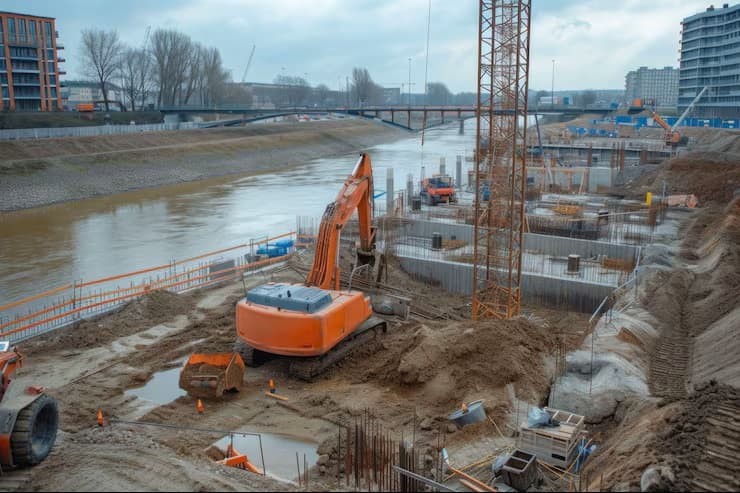
Designing foundation systems for high-rise buildings in weak soil or coastal environments is one of the most technically demanding challenges in structural and geotechnical engineering. Poor soil bearing capacity, high groundwater levels, consolidation settlement, and corrosion risks can threaten the stability of tall structures if the wrong foundation system is used. Selecting the right foundation system for high-rise buildings in weak soil ensures long-term safety, cost efficiency, and structural reliability.
Contact The Building Practice Ltd
Phone: +234 904 9721 840
Email: info@buildingpractice.biz
Address: Plot 6, Remi Olowude Street, Lekki Phase 1, Lagos
Website: The Building Practice Ltd
Stay connected with The Building Practice
Follow @thebuildingpractice on Instagram for professional insight for expert insights on top architectural design and innovation.
Why Weak and Coastal Soils Are a Major Risk for High-Rise Foundations
Soil Instability, Settlement, and Bearing Capacity Limits
Weak soils, such as soft clay, loose sand, peat, or reclaimed land, have low shear strength and high compressibility. Under the vertical loads of high-rise buildings, these soils experience:
- Excessive total settlement
- Differential settlement (uneven sinking)
- Bearing capacity failure
- Lateral soil movement
Even minor uneven settlement can cause structural cracking, column misalignment, and façade distortion, emphasizing why careful selection of foundation systems for high-rise buildings in weak soil is essential.
Effects of High Water Table and Saltwater Intrusion
Coastal zones often have a shallow groundwater table and saline conditions, increasing risks of:
- Reduced effective stress in soils
- Liquefaction susceptibility during seismic events
- Hydrostatic uplift on basements
- Corrosion of reinforcement
Structural Consequences of Poor Foundation Selection
Inadequate foundations in weak soils can lead to:
- Progressive structural distress
- Waterproofing failures
- Expensive underpinning and repair
- Reduced building lifespan
Choosing the right foundation system for high-rise buildings in weak soil is therefore a risk mitigation strategy.
Soil Investigation Requirements Before Foundation Design
Geotechnical Site Investigation Methods for Tall Buildings
Successful foundation systems for high-rise buildings in weak soil start with a thorough geotechnical survey, including:
- Borehole drilling
- Cone Penetration Testing (CPT)
- Standard Penetration Testing (SPT)
- Pressuremeter tests
- Geophysical surveys
Borehole Testing, SPT, CPT, and Laboratory Analysis
Lab tests determine:
- Atterberg limits
- Consolidation properties
- Shear strength
- Permeability
- Soil classification
These results guide decisions on pile depth, raft thickness, and ground improvement techniques.
Interpreting Soil Reports for Foundation Decision-Making
Engineers evaluate:
- Allowable bearing pressure
- Settlement tolerance
- Depth to competent strata
- Groundwater conditions
- Seismic soil classification
Key Engineering Challenges in Weak and Marine Soil Zones
Differential Settlement in Soft Clay and Loose Sand
Tall buildings amplify uneven ground movement due to rigid structural systems.
Liquefaction Risks in Coastal and Reclaimed Land
During earthquakes, saturated loose sand can behave like a liquid, compromising foundation integrity.
Corrosion Threats to Substructure Elements
Saltwater and high groundwater can reduce reinforcement durability, making protection measures crucial.
Pile Foundation Systems for High-Rise Buildings
Pile foundations are among the most reliable foundation systems for high-rise buildings in weak soil, especially in areas with poor surface soils.
Driven Piles for Deep Load Transfer
- Precast concrete or steel
- High load capacity
- Suitable for dense sand layers
Bored Cast-in-Situ Piles
- Common in urban high-rises
- Large diameters handle heavy vertical loads
- Minimal vibration, ideal for sensitive neighboring structures
Steel vs. Reinforced Concrete Piles in Marine Conditions
Concrete piles with corrosion-resistant reinforcement perform better in saline soils, extending foundation life.
Raft (Mat) Foundations in Low Bearing Capacity Soils
When Raft Foundations Are Feasible
Rafts distribute load over large areas when soil strength is moderate, reducing differential settlement.
Load Distribution Benefits
- Rigid structural plate spreads loads evenly
- Reduces localized settlement
- Can be combined with piles for higher safety
Limitations
Not suitable for very soft or deep compressible soils.
Piled Raft Foundations for Combined Performance
A piled raft is increasingly popular for high-rise buildings in weak soil.
How Piled Raft Systems Reduce Settlement
Piles control primary settlement while the raft distributes loads evenly.
Load Sharing Mechanism
Raft supports part of the load; piles handle the rest, optimizing structural performance.
Cost-to-Performance Advantage
Reduces the number of piles needed without compromising safety.
Caisson and Drilled Shaft Foundations
Large-diameter deep foundations used for extremely heavy structures.
Suitability
Ideal where weak soils extend to significant depths.
Construction in High Groundwater
Requires slurry stabilization, casing, or cofferdam techniques.
Structural Capacity
Supports heavy axial and lateral loads effectively.
Ground Improvement Techniques Supporting Foundations
Sometimes soil is strengthened before foundation installation to enhance foundation system performance.
Vibro Compaction and Stone Columns
Densifies loose granular soils to reduce settlement.
Deep Soil Mixing
Cement stabilizes soft clay for increased load-bearing capacity.
Preloading and Vertical Drains
Accelerates soil consolidation, reducing post-construction settlement.
Foundation Protection in Coastal and Marine Environments
Anti-Corrosion Measures
- Epoxy-coated rebars
- Cathodic protection
- High-performance concrete
Waterproofing
Essential for basements below the water table.
Durability Design
Long-term service life modeling ensures sustainable foundation performance.
Cost Implications of Foundation Choices
Foundation systems for high-rise buildings in weak soil can represent 20–35% of total construction costs.
Cost Drivers
- Depth to competent soil
- Material and construction method
- Groundwater management
Long-Term Risks
Inadequate design may lead to costly repairs or retrofitting.
Building Codes and Design Standards
Design must comply with:
- Geotechnical and structural codes
- Seismic design standards
- Durability exposure classifications
RECOMMENDED:
The Complete High-Rise Building Design Process: From Concept to Construction
Structural Systems Used in High-Rise Buildings and How They Affect Cost & Safety
Cost of Constructing a High-Rise Building in Nigeria: Budget, Materials, and Risks
Sustainable High-Rise Building Design: Energy Efficiency, Materials, and Long-Term Value
How Engineers Select the Best Foundation System
Structural Load Analysis
Evaluates vertical, lateral, wind, and seismic loads.
Soil–Structure Interaction Modeling
Advanced software predicts settlement, bearing, and performance.
Risk Assessment
Safety factors, redundancy, and monitoring are key to high-rise foundation reliability.
Common Foundation Failures in Weak Soil High-Rise Projects
- Uneven settlement
- Tilting or misalignment
- Basement leakage
- Reinforcement corrosion
Future Innovations in High-Rise Foundation Engineering
- Smart sensors for real-time settlement monitoring
- Sustainable and high-performance materials
- AI-driven geotechnical modeling and simulation
Selecting the Right Foundation Systems for High-Rise Building Stability
Selecting the right foundation systems for high-rise buildings in weak soil ensures structural stability, durability, and safety. Piles, rafts, piled rafts, caissons, and ground improvement methods each serve specific soil and load conditions. Careful geotechnical investigation and design are critical to avoid costly mistakes.
Planning a high-rise project on weak or coastal soil?
Avoid costly foundation failures. Our team specializes in deep foundation systems, piled rafts, and advanced soil improvement solutions for high-rise buildings in weak soil conditions. Contact our experts today to ensure your project is safe, durable, and cost-efficient from the ground up.
Contact The Building Practice Ltd
Phone: +234 904 9721 840
Email: info@buildingpractice.biz
Address: Plot 6, Remi Olowude Street, Lekki Phase 1, Lagos
Website: The Building Practice Ltd
Stay connected with The Building Practice
Follow @thebuildingpractice on Instagram for professional insight for expert insights on top architectural design and innovation.
Frequently Asked Question About High-Rise Foundation Systems for Weak & Coastal Soil
What is the best foundation system for high-rise buildings on weak soil?
A piled raft or deep pile foundation is generally the most reliable option because it transfers structural loads to stronger soil layers while controlling settlement and improving overall stability.
Why are pile foundations preferred for skyscrapers in coastal areas?
Pile foundations bypass weak surface soils and anchor into deeper competent strata, reducing settlement risks and improving resistance to liquefaction, groundwater pressure, and corrosion caused by saline conditions.
What is a piled raft foundation and why is it used in high-rise construction?
A piled raft combines a reinforced concrete raft with strategically placed piles, allowing both components to share structural loads and significantly reduce settlement in weak or compressible soils.
Can raft foundations alone support a high-rise building?
Raft foundations can support tall buildings only when soil bearing capacity is adequate. In very soft or deep compressible soils, they must be supplemented with piles to ensure stability.
What soil tests are required before designing a high-rise foundation?
Typical investigations include borehole drilling, Standard Penetration Tests (SPT), Cone Penetration Tests (CPT), and laboratory tests for shear strength, consolidation, and soil classification.
What causes foundation failure in weak soil high-rise projects?
Foundation failures commonly result from inadequate geotechnical investigation, improper load transfer design, poor groundwater control, and long-term corrosion of foundation materials.